Quick answer: Victoria Falls exists because the Zambezi River crosses a basalt plateau laced with ancient, softer fracture lines. The river cuts down through one crack, then works backwards along it until it reaches the next crack and jumps sideways to it — which is exactly why the gorge below the current Falls zig-zags instead of running straight. The Falls you see today is simply the newest edge of a process that's been running for roughly two million years, and isn't finished yet.
On This Page
The 180-Million-Year-Old Rock
Long before there was a waterfall, there was a lava flow. Around 180 million years ago, volcanic activity across what's now southern Africa left behind a thick sheet of basalt — dark, dense rock that cooled slowly and cracked as it did, leaving a network of fractures running through it in several different directions. Most of the time this rock just sits there being geology. Then a river shows up with somewhere to be.
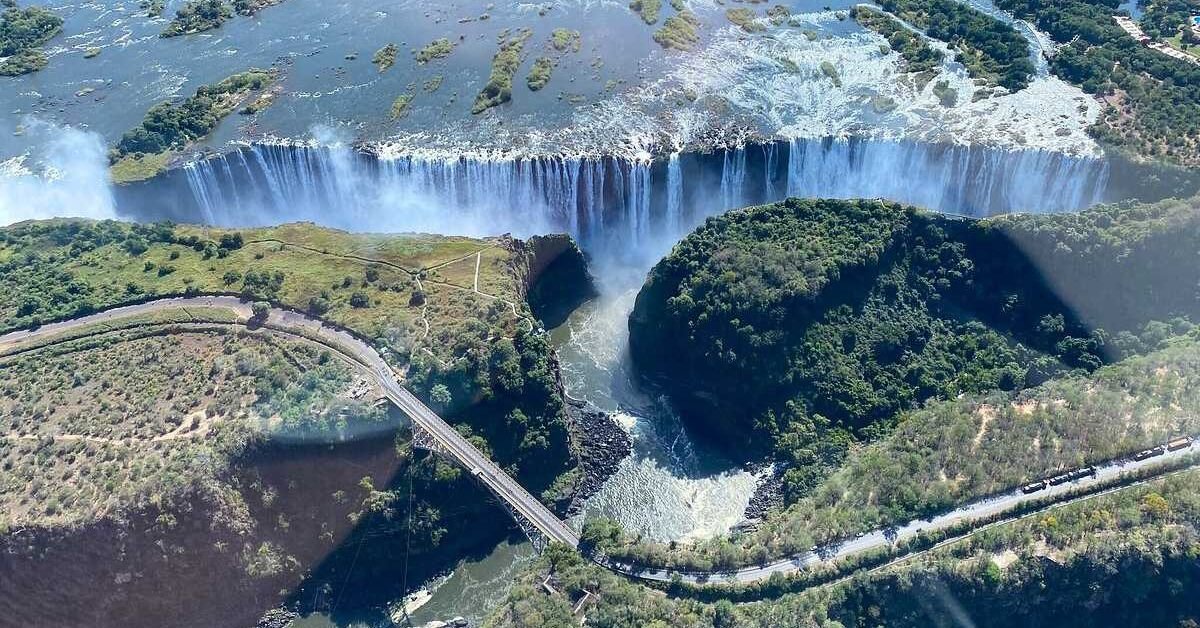
Why The Gorge Zig-Zags
The Zambezi doesn't cut through solid basalt at random. It finds the weakest point — one of those old fracture lines — and erodes along it, widening and deepening a gorge over time. Eventually the river cuts back far enough through that crack to reach the next one, and because the fractures don't all run in the same direction, the river jumps sideways onto a new line at an angle. Do this half a dozen times over roughly two million years and you get exactly what you see from a helicopter flight over the Falls today: a gorge that zig-zags downstream instead of running in a straight line, each bend marking a jump to an older crack the river has already abandoned.
Which, unprompted, is a genuinely good argument for taking the helicopter flight instead of just reading about it.
A Waterfall That's Still Moving
Here's the part most visitors don't expect: Victoria Falls has already done this several times before, and it's going to do it again. The waterfall itself is just the current, active edge of that fracture-jumping process — the modern version of something that's been retreating upstream for roughly two million years. Geologists expect the next shift, into the next fracture line upstream, to take place over tens of thousands of years. So no, you don't need to book your trip early to beat it. But you are looking at a waterfall mid-migration, not a finished one.
One Name, Two Meanings
Locally, the Falls are known as Mosi-oa-Tunya — "The Smoke That Thunders" — a name that predates the European one by generations and describes exactly what you see from a distance: a column of spray visible for kilometers, rising off a drop you can hear before you see it. Scottish explorer David Livingstone renamed it Victoria Falls in 1855, after Queen Victoria, and both names are used interchangeably on both sides of the border today. For the full location, size and history breakdown, see our guide on where Victoria Falls actually is.
Want to see the geology up close rather than just read about it? Our guided Falls tour walks the rainforest trail along the gorge edge, and the Flight of Angels helicopter tour is the only way to see the full zig-zag pattern in one glance. Send us your dates and we'll build it into your itinerary.
Frequently Asked Questions
Related Topics